Plant roots could store more carbon than previously expected at greater depths
 Konstantinos Kourtidis Attribution-NonCommercial-ShareAlike 3.0 Unported CC BY-NC-SA 3.0 Deed
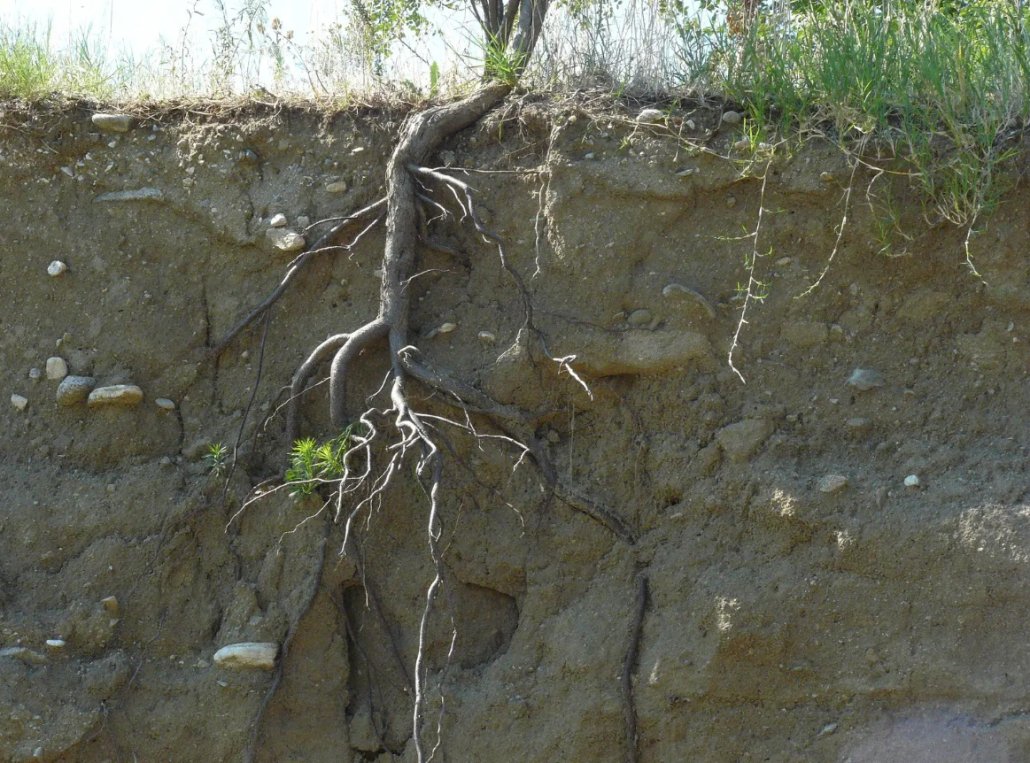
An American study reveals the existence of a second layer of roots developed by several plant species—often overlooked—that enables additional carbon sequestration
by Matteo Cavallito
As they grow deeper into the soil to absorb nutrients and water, many plants develop a second layer of roots, thereby accessing additional nutrient resources. This is the discovery made by a group of American researchers from Stanford University, in collaboration with institutions including Boston College, Columbia University, Dartmouth College, and the Center for Tree Science in Lisle, Illinois.
In their recent study, published in Nature Communications, the authors argue that plants could therefore transport and store carbon deeper in the soil than previously thought—carrying significant implications for climate mitigation goals.
A Limited Understanding of Root Systems
Plants, of course, must meet their nutritional requirements, while also supporting the soil’s role as a carbon sink. At the center of this balance, the study notes, are the roots. But understanding of root system dynamics, the researchers explain, has so far been incomplete.
“Recent studies have greatly improved our understanding of plant roots through the study of their ‘traits’, ranging from morphological traits such as root diameter to root-symbiont relationships such as mycorrhizal colonization rate, in part thanks to the rise of publicly available harmonized root trait data,” the researchers explained.
However, they continued, “These trait data mostly reflect micro-scale properties of individual root segments (e.g., root diameter, root nitrogen concentration). A rooting-system level understanding of how these roots are distributed throughout the soil matrix still lags far behind, limiting our ability to scale up local, trait-based measurements to ecosystem-scale properties.”
The Discovery of the Second Root Layer
Researchers used data from the National Ecological Observatory Network (NEON) to examine root depth. The NEON dataset includes samples taken as deep as two meters—far beyond the 30 cm range of traditional ecological studies—at 44 different sites across the United States. This unprecedented depth allowed researchers to detect new root patterns across various climate zones and ecosystem types, from the Alaskan tundra to the rainforests of Puerto Rico. It was precisely in the deeper layers of the soil that researchers observed, in some cases, a “bimodal” root distribution.
That is, two distinct peaks of fine root biomass along the soil profile, indicating two depth levels with significant root concentrations. In short, a second “peak” of roots.
This additional layer appears to have developed in response to favorable deep-soil conditions such as greater availability of nitrogen or water. It reveals previously unknown, yet fairly widespread, growth dynamics. In fact, the bimodal root distribution was found at 9 of the NEON sites—about 20% of the total—with no apparent link to geographic location.

According to the study, 9 out of 44 (~20%) sites in the NEON dataset have bimodal root distributions. Image: Lu, M., Wang, S., Malhotra, A. et al. A continental scale analysis reveals widespread root bimodality. Nat Commun 16, 5281 (2025). https://doi.org/10.1038/s41467-025-60055-2 Attribution-NonCommercial-NoDerivatives 4.0 International (CC BY-NC-ND 4.0 Deed)
In the Future, We’ll Need to Look Deeper Underground
The implications of the research are clear. As lead author Mingzhen Lu, professor at New York University and researcher at Stanford, explained: “Understanding where plants grow roots is vital, as deeper roots could mean safer and longer-term carbon storage. Harsher conditions at depth may prevent detritus-feeding microbes from releasing carbon back to the atmosphere.”
He added: “The good news is plants may already be naturally mitigating climate change more actively than we’ve realized—we just need to dig deeper to fully understand their potential.”
To do so, however, we must focus more attention on underground processes—often overlooked by current observation systems. As Lu concluded: “Scientists and policymakers need to look deeper beneath the Earth’s surface as these overlooked deep soil layers may hold critical keys for understanding and managing ecosystems in a rapidly changing climate.”
 Mokkie/Wikimedia Commons – CC BY-SA 3.0
 Yuriy Kvach/Wikimedia Commons – CC BY-SA 4.0
 © European Union 2018 (photo by Pavel Koubek), CC BY-NC-ND 2.0