France is the latest victim of global desertification
 The National Scientific Committee estimates that 1.4 percent of France's soil-more than 750 thousand hectares-is prone to desertification. Photo: iJuliAn Attribution-NonCommercial-ShareAlike 2.0 Generic CC BY-NC-SA 2.0 Deed
 Late last year, France was added for the first time to the UN list of countries declared affected by land degradation and desertification. A phenomenon that impacts more than 3 billion people worldwide
by Matteo Cavallito
Desertification is an increasingly common emergency. A particularly widespread problem, even larger than people think. Recently, in this sense, a particular national case has managed to attract some attention, establishing itself as an emblematic example of the global nature of the phenomenon. At the end of last year, in fact, the United Nations updated the list of countries declared affected by land degradation and desertification by welcoming a new member to the unenviable list. This was not any African state from the Sahel nor any nation from the endless Asian steppes, but rather the 14th EU member to join the club: France.
Desertification affects more than 3 billion people
In December, Reporterre magazine recalls, France was thus added to the list of 169 other states subject to the problem, According to Thani Mohamed Soilihi, the head of the French delegation at the Conference of the Parties to the United Nations Convention to Combat Desertification (UNCCD) in Riyadh, Saudi Arabia, this represents “another step toward greater awareness of this reality.”
Desertification, or land and soil degradation in drylands, is promoted by several factors. These include, of course, climate change, which results in extreme weather events. But also loss of fertility and declining availability of water supplies. According to the Institut de recherche pour le développement (IRD), a French research organization based in Marseille, global desertification currently affects 3.2 billion people. And threatens 40 percent of the Planet’s surface area excluding Antarctica.
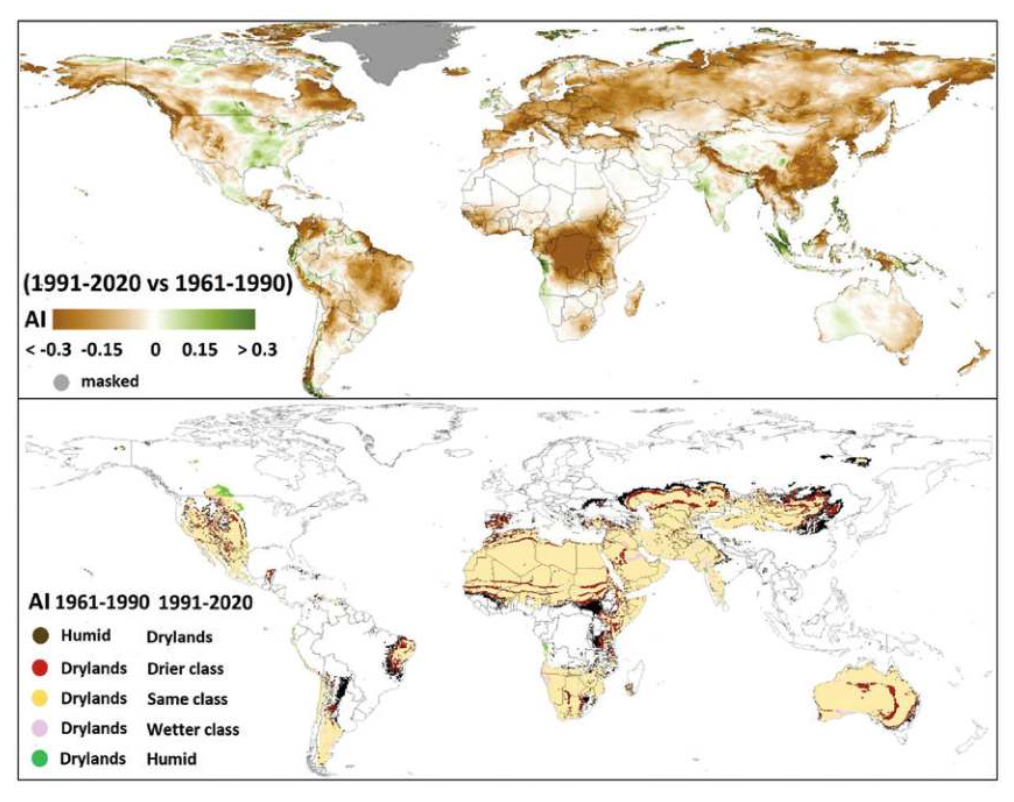
The evolution of aridity. The upper panel shows the difference between aridity index (AI) values over the period 1961-1990 and the period 1991-2020. Green indicates wetter conditions, brown drier conditions (Greenland is masked in the upper panel because the AI shows large variations due to snow, with no shifts from the cold AI class). The lower panel shows shifts between AI classes during the periods mentioned above. The black areas are the hotspots exposed to aridification. SOURCE: Unccd Aridity report, 2024.
Three-quarters of soils are drier than 30 years ago
One of the most problematic aspects of desertification is its status of being an evolving phenomenon. In fact, the phenomenon, revealed a recent report (“The Global Threat of Drying Lands”) produced by the UN Convention itself, has been on the rise for 30 years now. A period in which drylands have grown by 4.3 million square kilometers and 77.6 percent of the landmass has become drier. And that’s not all.
7.6 percent of global soils or an area larger than Canada have been pushed beyond the threshold of aridity (i.e., no longer classified as non-arid). With obvious impacts on agriculture, ecosystems and people.
In the absence of action to mitigate global warming and greenhouse gas emissions, it is estimated that another 3 percent of wetlands will become arid by the end of the 21st century. When, according to the same forecast, the number of people affected by the phenomenon will reach 5 billion.
In France over 750 thousand hectares of desertified soil
What about France? The numbers, so far, are significantly lower in comparison with other countries. But they still give pause for thought. In 2024, the French Scientific Committee on Desertification (CSFD), in collaboration with the Nitidae association, updated its assesment of the phenomenon on a national scale after a decade.
In France, the dry arid, semi-arid and sub-humid area amounts to almost 1 million hectares, or 1.8 percent of the total. In 30 years (1993-2022), moreover, about 39% of the territorye xperienced a transformation of its climate, which became drier.
But there is more. Today, the Committee explains, 3.2 percent of French soil (over 1.7 million hectares) is considered degraded “on the basis of the three indicators indicated by the Convention”. These are land cover, vegetation productivity and sequestered organic carbon stock. According to these parameters, desertification affects about 76 thousand hectares of land in France. Taking into account the indicators suggested by the JRC, the European Commission’s Joint Research Center), however, it comes to over 750K or 1.4 percent of the total area.
 Penn State. Attribution-NonCommercial-NoDerivatives 4.0 International, CC BY-NC-ND 4.0 Deed.
 Eric Guinther, CC BY-SA 3.0
 Warren LeMay CC BY-SA 2.0