Wildfires in Canada are a serious and worsening problem
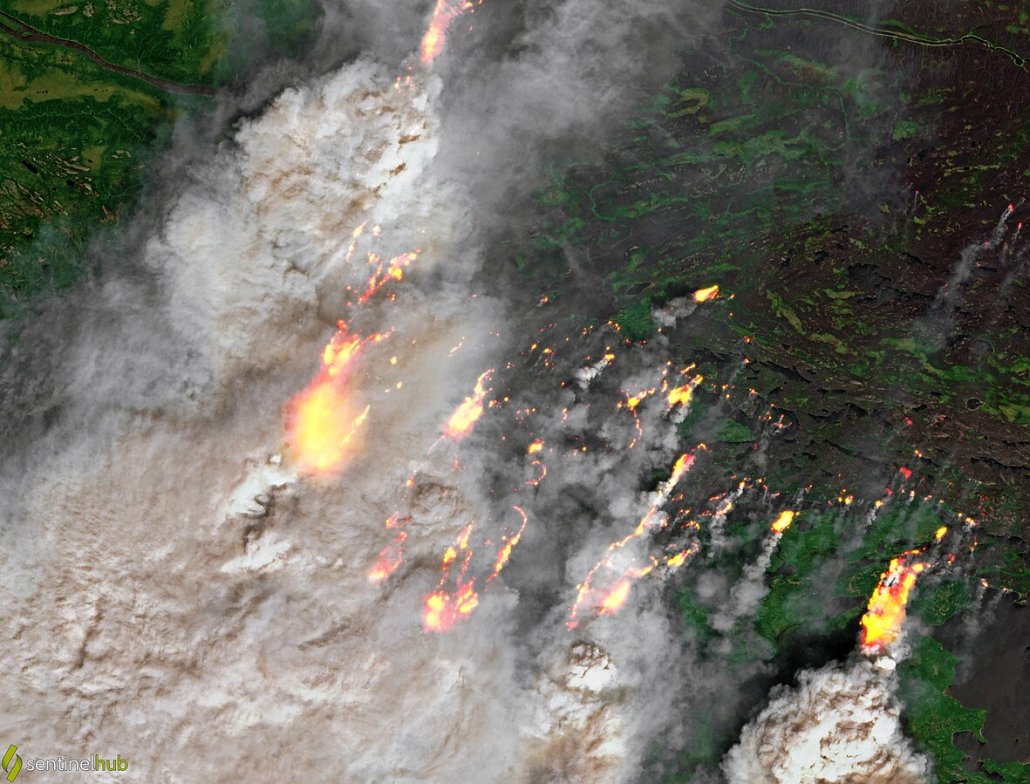 Pierre Markuse modified Copernicus Sentinel data 2023 Attribution 2.0 Generic CC BY 2.0 Deed
 Wildfires in the country are no longer just a seasonal phenomenon, according to an expert at the University of Ottawa. Drought amplifies the role of all crucial factors
di Matteo Cavallito
In Canada, climatic factors are increasing the intensity and frequency of wildfires, which have now ceased to be a simple seasonal phenomenon. This is claimed by Hossein Bonakdari, a professor at the University of Ottawa, in an article published in The Conversation. “Wildfire season in Canada has historically spanned from late April to August — with the most damaging of these fires typically burning in June and July” he writes. “But in recent years, we’ve seen a significant change in when wildfires burning.”
For example, he says, “in 2024, Alberta’s wildfire season started in February due to the province’s warm and dry conditions. Québec recorded its forth earliest wildfire since 1973 in mid-march of the same year. British Columbia then reported their first wildfires of the season shortly after.” And none of this, of course, happens by accident.
Drought boosts wildfires
There are three elements that favor wildfires, Bonakdari explains: vegetation that acts as fuel, natural or human ignition, and favorable conditions such as hot, dry weather and the presence of wind. Playing a decisive role, however, is drought, a phenomenon that eventually exacerbates the impact of the other factors.
“Droughts not only dry vegetation — which gives wildfires more fuel — they also prolong hot, dry and windy weather,” he writes. “This further creates a high-risk environment for wildfires to ignite and spread.”
The numbers, moreover, are clear. In Canada in 2024, water scarcity affected 43 percent of land and 35 percent of agricultural land. Areas with low soil moisture experienced, inevitably, an increase in wildfires.
Interface zones are a risk factor
The drought also combines with another factor: the presence of so-called interface zones, which, according to the author, contributed to the severity of the most recent wildfires in California (29 fatalities, more than $250 billion in damage). “The wildland-urban interface (WUI) are areas where natural, undeveloped vegetation meets human development. This creates a high-risk zone where flammable plants and structures combine — increasing the chance of wildfires spreading from wildlands to communities.”
And Canada, where there has long been an expansion of these areas, is certainly no exception, with an increased risk of flames near large cities.
“In Canada, the WUI is rapidly expanding as large cities contend with population growth,” the author continues. “But this is putting even more Canadians at risk from potentially detrimental wildfires. The recent, severe wildfires in California’s WUI areas offer a clear warning for Canada, highlighting an urgent need to address the risks associated with these rapidly growing zones.”
Prevention needed
The early fire season recorded in 2024 follows the catastrophes of the previous year when Canada had to deal with more than 18.4 million hectares of burned forests and some 232,000 evacuees in several provinces. Notable, of course, was the climate impact: the flames produced more than three times the CO2 emissions of the national transportation sector. Inevitable, in short, to think about the need for prevention and mitigation in the future.
The author, in particular, suggests the use of an indicator known as the Leaf Area Index (LAI), which measures vegetation density that, in turn, is correlated with increased vulnerability to fire.
It is also necessary to take fire risk into account when designing urban development policies, which, in Canada, call for the construction of nearly 3.9 million new housing units by 2031. “By pinpointing Canada’s most vulnerable regions, targeted wildfire prevention strategies can be carried out to mitigate risks and enhance community resilience in the face of escalating wildfire threats,” the professor concludes. “This might include reducing the amount of dry vegetation, carrying out controlled burns and building fire-resistant infrastructure.”
 Gareth James CC BY-SA 2.0 Attribution-ShareAlike 2.0 Generic
  Mokkie/Wikimedia Commons – CC BY-SA 3.0
 Yuriy Kvach/Wikimedia Commons – CC BY-SA 4.0