
Climate change increases mortality caused by extreme temperatures

Study tracks future climate mortality in Europe: fewer deaths from cold weather but many more casualties from extreme heat. The Mediterranean will pay the highest price
by Matteo Cavallito
During the 21st century, deaths related to extreme temperatures in Europe are set to increase. The trend will be particularly evident in the Mediterranean area, the region most vulnerable to the phenomenon. That is the conclusion of a study published in the journal Nature Medicine. The survey, which involved several research centers and health departments on the Continent, found that the expected decrease in cold-related deaths will not be enough to offset the increase in deaths resulting from excessive heat.
Worst case scenario: more than 2.3 million deaths by 2099
The study analyzed the impact of climate change on 854 European cities from 2015 to 2099. In the absence of adaptation measures, the authors explain, the upward trend will find continued confirmation. “With no adaptation to heat, the increase in heat-related deaths consistently exceeds any decrease in cold-related deaths across all considered scenarios in Europe,” the study explains.
In the worst-case scenario, the authors continue, they estimate “a net death burden due to climate change increasing by 49.9% and cumulating 2,345,410 climate change-related deaths.”
This assumption, the research points out, predicts a total average warming of 4°C above pre-industrial levels that would bring the death rate up to 41.7 deaths per 100,000 people. If it were possible to contain the temperature increase to a maximum of 1.5°C, on the other hand, the impact would be significantly smaller with a mortality rate of 3.5 per 100,000.
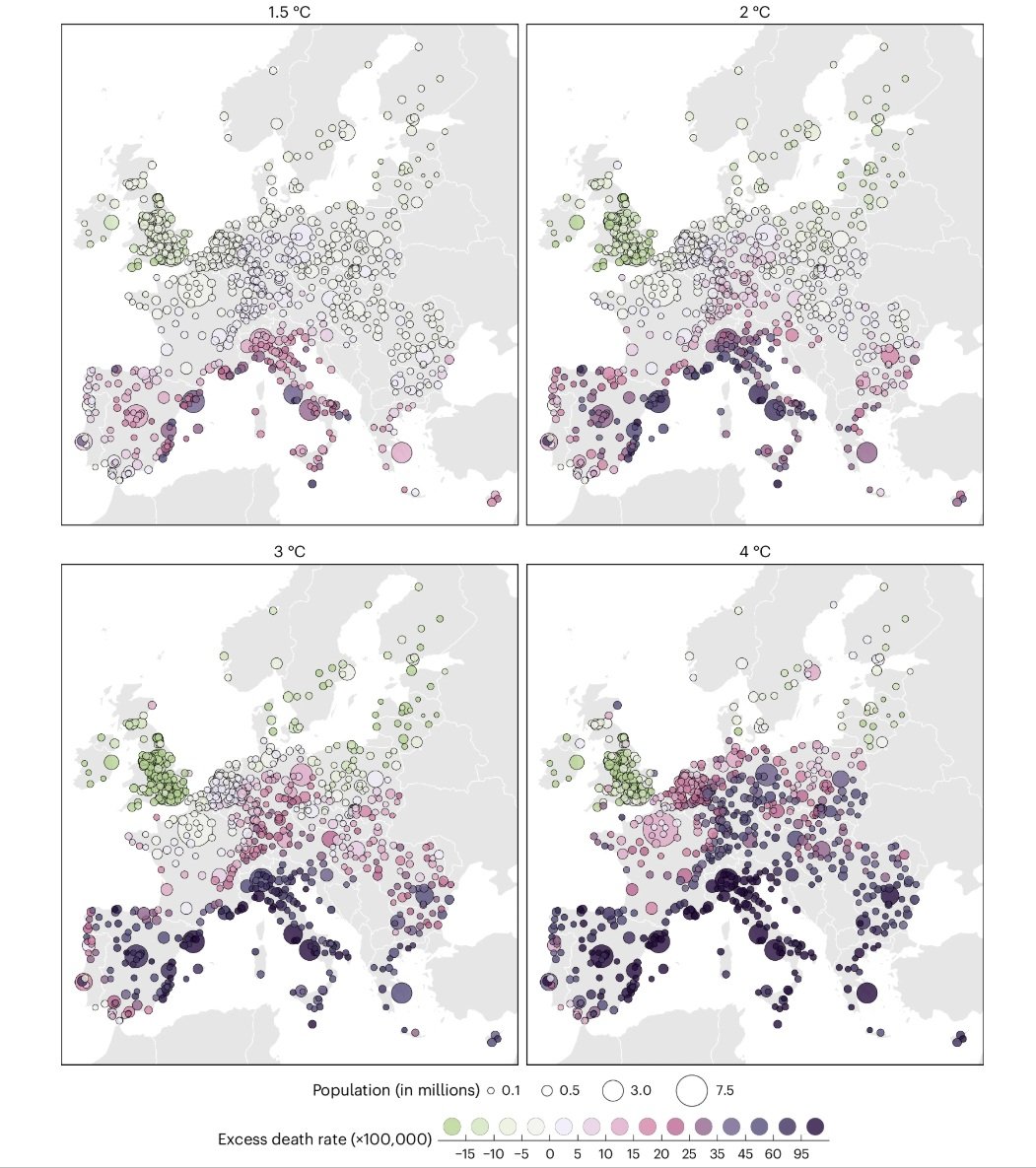
City-level net changes in temperature-related excess death rates for each warming level under no adaption to heat scenario. Panels from top-left to bottom-right represent warming levels from 1.5 °C to 4 °C. Green colors indicate a decrease of temperature-related excess deaths while purple colors indicate an increase. Image: Masselot, P., Mistry, M.N., Rao, S. et al. Estimating future heat-related and cold-related mortality under climate change, demographic and adaptation scenarios in 854 European cities. Nat Med (2025). https://doi.org/10.1038/s41591-024-03452-2 Attribution 4.0 International CC BY 4.0 Deed
Mediterranean epicenter of the crisis
Climate change, the research points out, exacerbates existing regional differences in Europe. While some areas in the north may see a slight improvement, others in southern and eastern Europe could face significant increases in temperature-related mortality.
Particularly exposed to this risk are the Balkan regions and the Mediterranean area, already the focus of continental desertification, “with the highest net effects in Eastern Spain, Southern France, Italy and Malta.”
Malta, the research continues, “is the only country with estimated net increases in temperature-related deaths across all scenarios; the net death rate increase could reach up to almost 200% of the early twenty-first century levels. The increase could also exceed 80% in Spain.”
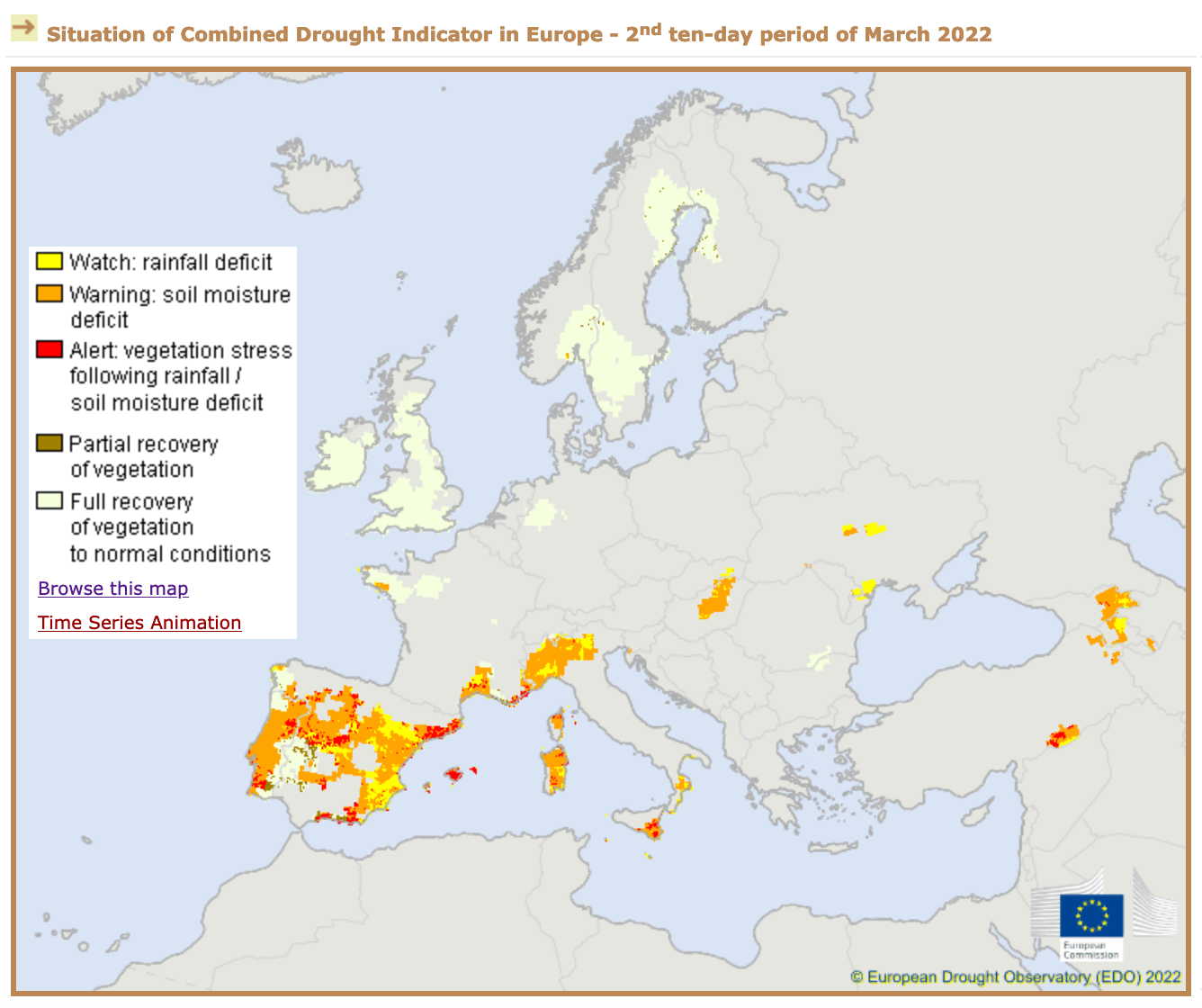
Desertification in Europe – 3rd decade March 2022. Combined drought indicator. SOURCE: JRC European Drought Observatory (EDO) March 2022.
With stronger policies, mortality could be reduced by two-thirds
Among cities, some large centers in the southern part of the Continent, such as Rome, Barcelona, Marseille and Naples, could face significant increases in heat-related deaths. At the same time, some Northern European cities, such as Aberdeen, Stockholm, and Helsinki, could benefit from lower cold-related mortality.
This reduction, however, would fail to offset the overall impact of climate change.
“Unless strong mitigation and adaptation measures are implemented, most European cities should experience an increase of their temperature-related mortality burden,” the study concludes. In contrast, if particularly stringent initiatives were taken, the projected excess deaths “could be reduced by at least two-thirds, outlining the health benefits of implementing strong policies to reduce carbon emissions.”
 Eric Guinther, CC BY-SA 3.0
 Warren LeMay CC BY-SA 2.0
 Tom Jarrett, Attribution-NonCommercial-ShareAlike 2.0 Generic (CC BY-NC-SA 2.0) Deed


