Only one-third of water bodies in Europe is in good condition
 Photo: Pexels free for personal and commercial purposes
According to the latest report of the EU Environment Agency, the use of pesticides in agriculture continues to impact water quality in Europe. That’s why we need to improve the management of aquatic ecosystems to increase resilience
by Matteo Cavallito
Agriculture is the main source of impact on Europe’s surface water and groundwater, on which there is a strong demand for use as well as pollution due to intensive use of nutrients and pesticides. A trend set to intensify due to climate change. This is stated in the latest report by the European Environment Agency (EEA).
‘Pollution, habitat degradation, impacts of climate change, and the over-use of freshwater resources are putting pressure on Europe’s lakes, rivers, coastal waters and groundwaters like never before,’ explains a statement. ‘”Europe is not on track to meet its targets to improve the health of waters under EU rules’. In this scenario, ‘Better water management is key to improve water resilience’.
Two thirds of surface waters are in good condition
Carried out by processing data provided by 19 states, the study periodically paints a picture of the situation for 85% of the surface water bodies (a total of 120,000) and 87% (3.8 million km2) of the groundwater area in the European Union and Norway. The scenario that emerged, the authors explain, is not reassuring.
Only 37% of European surface water bodies have achieved ‘good’ or ‘high’ ecological status, a specific measure of the health of aquatic ecosystems, and only 29% of them show ‘good’ chemical status in the 2015-2021 period.
According to the report, despite some progress, European waters and aquatic ecosystems are still severely impacted by chemicals, mainly due to air pollution from coal-fired power generation and the accumulation of nutrients and pesticides from agriculture. Habitat degradation is also widespread. Finally, climate change is disrupting weather patterns and further increasing pressures on water resources.
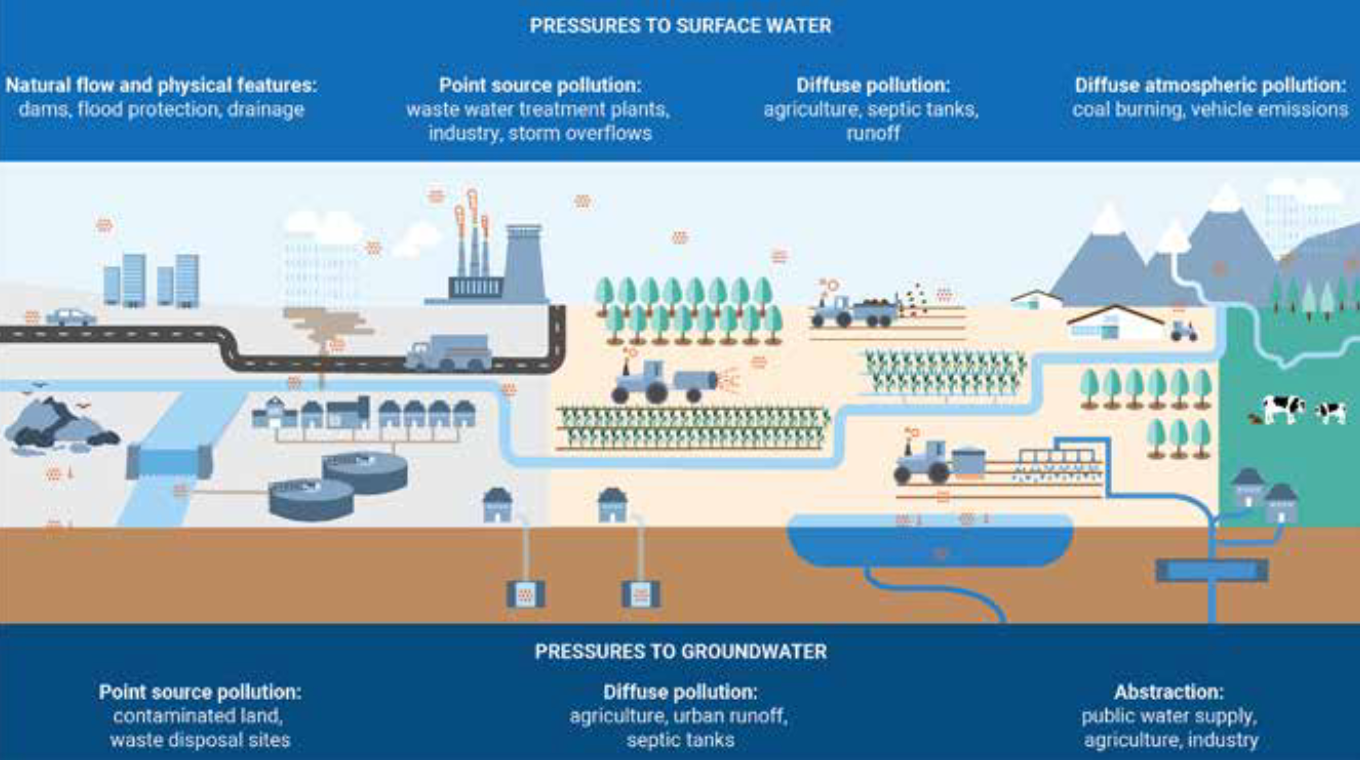
Factors adversely affecting surface and groundwater quality in Europe. SOURCE: EEA EU Environment Agency.
On water protection, Europe is lagging behind
To date, the measures taken by Member States have had some effect in mitigating the phenomenon by preventing further deterioration of the water status. by limiting the use of certain chemical pollutants and changing the outlook for some species in the affected ecosystems for the better. But no general improvement has been detected so far since the last monitoring cycle.
The same applies to groundwater, which also appears to be in better condition than its surface counterparts ‘with 77% of it in good chemical and supply status and 91% in good quantitative status’.
But even for them, problems of agricultural contamination remain evident, with excessive accumulation of nutrients and pesticides impacting on the availability of drinking water. Efforts at the EU level, in short, have not been sufficient so far. ‘The deadline set by the EU’s Water Framework Directive (WFD) to meet good status for surface and groundwaters was 2015,’ the statement observes. ‘and at the latest by 2027. At the rate of current progress, this will not be met.’
Recommendations
So what steps should be taken? Reducing water use and improving efficiency are crucial, the authors explain. The setting of targets and the use of up-to-date and timely information are necessary in this respect. In addition, pressures on water resources must be reduced by preventing pollution and reducing the release of pollutants and nutrients into the water.
Restoring nature, reconnecting rivers and their floodplains andregenerating wetlands and peatlands can make freshwater ecosystems healthier and richer in biodiversity, providing a qualitatively better resource while storing carbon and mitigating the impact of extreme weather events.
 Mokkie/Wikimedia Commons – CC BY-SA 3.0
 Yuriy Kvach/Wikimedia Commons – CC BY-SA 4.0
 © European Union 2018 (photo by Pavel Koubek), CC BY-NC-ND 2.0