
Ending grazing reduces stable carbon levels in grasslands
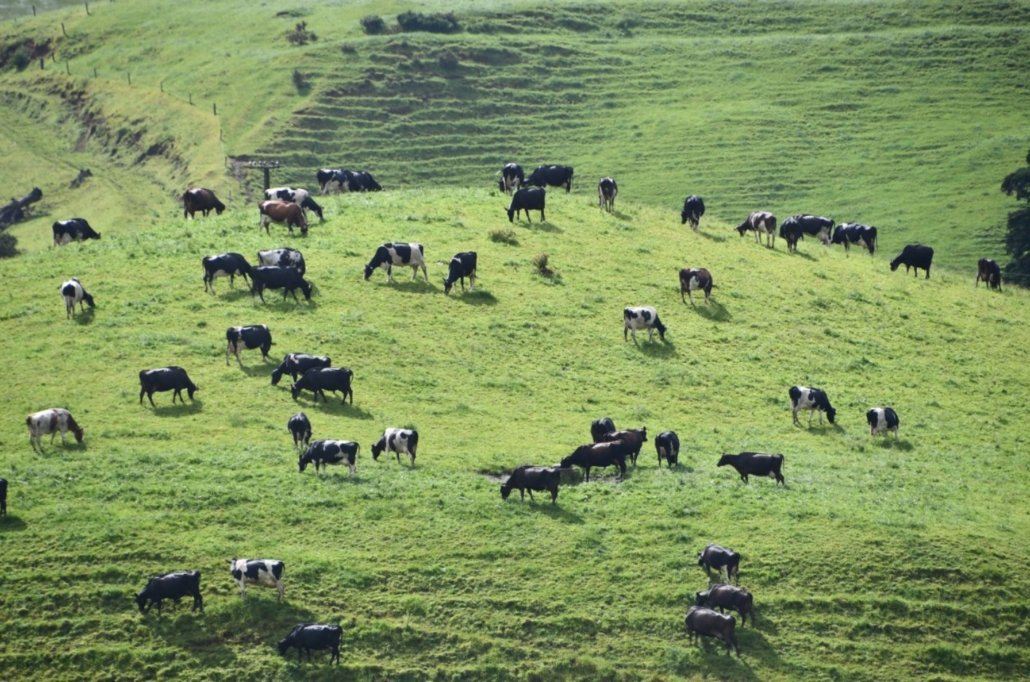 Pxhere CC0 Public Domain Free for personal and commercial use No attribution required
 According to British research, undisturbed grasslands accumulate more fast-cycle carbon in the soil than those with grazing livestock. However, they also have lower levels of stable carbon
by Matteo Cavallito
Removing livestock from grasslands could compromise long-term carbon storage in the soil. This side effect would call into question the very effectiveness of this strategy, which has historically been conceived as a climate mitigation tool. The hypothesis was presented by the University of Manchester, with a study published in Proceedings of the National Academy of Sciences. According to the research, removing pastures increases the accumulation of fast-cycle carbon stored in plants and dead vegetation but also leads to the loss of the most stable form of organic matter in the soil. This has a negative impact on climate in the long term.
The importance of stable carbon
“The removal of livestock grazers from historically grazed grasslands is widely proposed as a key strategy for the enhancement of soil organic carbon (SOC) for climate mitigation,” the study explains. “Yet, accurate assessments of how grazer exclusion impacts SOC pools of differing stability are lacking, with most studies focusing on total SOC rather than the distribution of SOC within fast and more stable, slow-cycling pools.”
These pools, in particular, consists of so-called mineral-associated organic carbon (MAOC) in the soil, which can persist for a very long time and therefore plays a key role in mitigation.
Grasslands currently store about one-third of the planet’s terrestrial carbon. However, they are subject to different carbon dynamics and the impact of livestock. “Although high grazing intensity can negatively affect soil carbon,” explains Luhong Zhou, lead author of the study and researcher at the University of Manchester, in a statement, “our results show that total grazer exclusion does not necessarily lead to greater long-term soil carbon storage.”
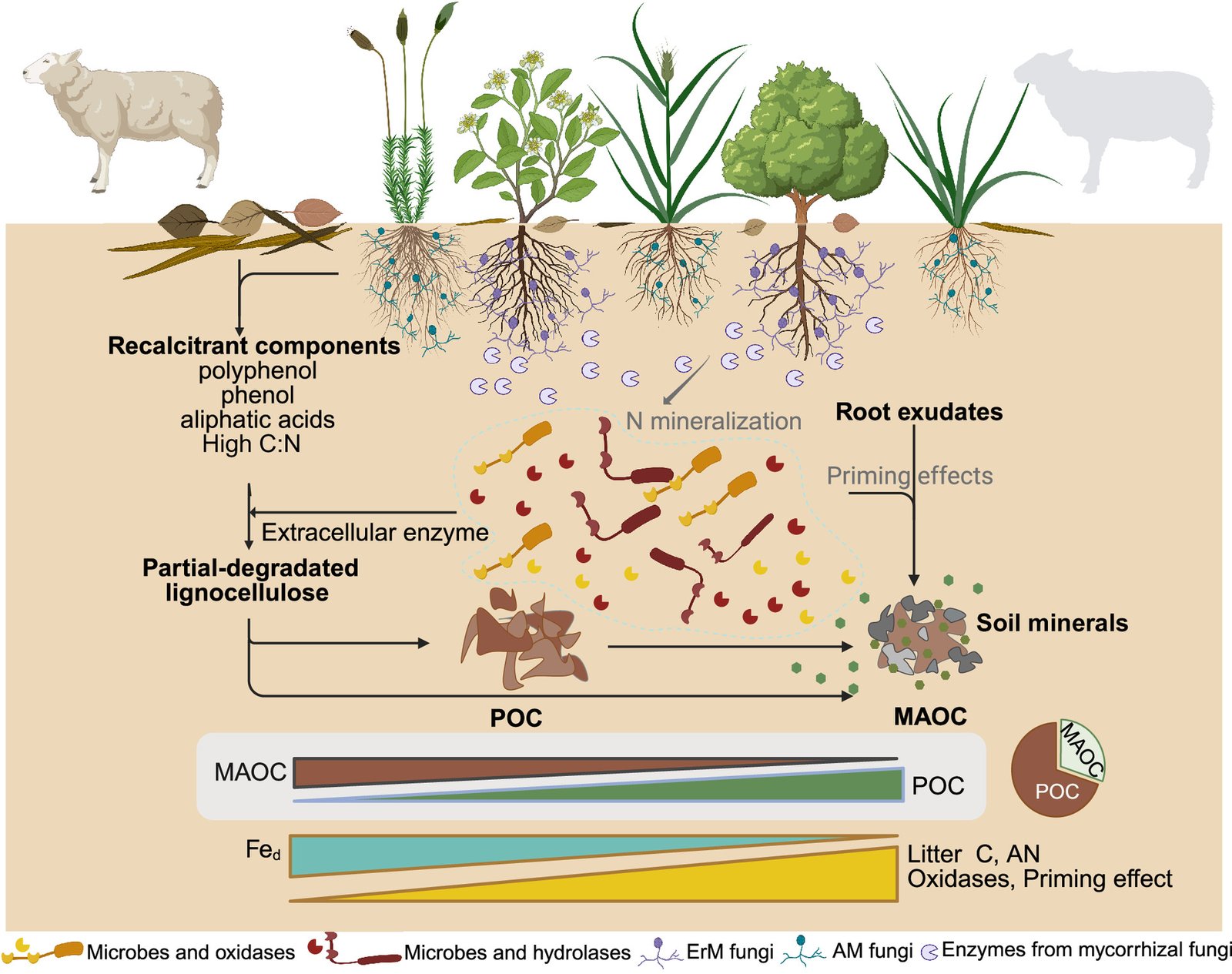
Key mechanisms by which grazing cessation influences soil organic carbon (SOC) pools. Grazing cessation leads to difference in litter quality, soil variables, and microbial processes, accompanied by a higher dominance of ericoid mycorrhizal shrubs. These differences in soil properties included a lower N limitation for the decomposition of recalcitrant litter, which primarily influences the accumulation of POC. In contrast, the lower MAOC in ungrazed grasslands was mainly driven by an enhanced priming effect through oxidases, with a lower mineral protection. Source: L. Zhou, S. Liu, M. Schrama, D. Ashworth, & R.D. Bardgett, Grazer exclusion is associated with higher fast-cycling carbon pools but lower slow-cycling mineral-associated carbon across grasslands, Proc. Natl. Acad. Sci. U.S.A. 123 (6) e2512048123, https://doi.org/10.1073/pnas.2512048123 (2026), Created with BioRender.com. Attribution 4.0 International CC BY 4.0 Deed
The study
During the research, which also involved the universities of Lancaster (UK), Yale (USA), Fujian (China), and Leiden (Netherlands), the authors examined 12 mountain grassland sites on an 800-kilometer south-north gradient in the UK, from the Dartmoor plateau in southwestern England to the Glensaugh area in Scotland. At each site, they compared land that had not been grazed for more than ten years with nearby areas that had been grazed by sheep during that period.
They found that ungrazed grasslands were more likely to accumulate more fast-cycle carbon in plant biomass and surface litter. But at the same time, they contained lower levels of organic carbon associated with minerals.
“Despite the positive effect of grazer exclusion on fast-cycling C pools, our findings reveal a concurrent negative effect on slow-cycling MAOC, which represents the more stable fraction of soil carbon as it resists microbial decomposition and can persist in the soil for decades to centuries,” the study notes. In comparison with soils grazed by livestock, specifically, the concentration of MAOC in ungrazed soils “was lower in ungrazed plots across sites by on average 6.44 g kg−1 and POC concentration was higher, albeit nonsignificantly.”
The role of fungi
Changes in vegetation following the removal of grazing sheep are decisive, explain the authors. Once-prevalent grass is being replaced in part by the spread of shrubs such as heather, whose roots form associations with a specialized fungus called ericoid mycorrhiza. These fungi slow down the decomposition of plant debris, causing an increase in short-lived carbon production.
In addition, they stimulate the decomposition of older, more stable carbon in the soil in order to extract nutrients.
Finally, wetter soils can also further weaken minerals that normally help protect the organic carbon associated with minerals. In short, the research highlights “the need to consider both the quantity and persistence of SOC in grassland management strategies.” For that reason, scientists suggest resorting to solutions that protect the most stable forms of carbon, which include maintaining low-intensity grazing in grasslands.
 Jonathan Wilkins Attribution-ShareAlike 3.0 Unported CC BY-SA 3.0 Deed
  Melissa McMasters Attribution 2.0 Generic CC BY 2.0 Deed
  Angal insect Attribution-ShareAlike 4.0 International CC BY-SA 4.0 Deed


