Soil, climate, and resilience: Bologna hosts the Agricultural Chemistry Winter School
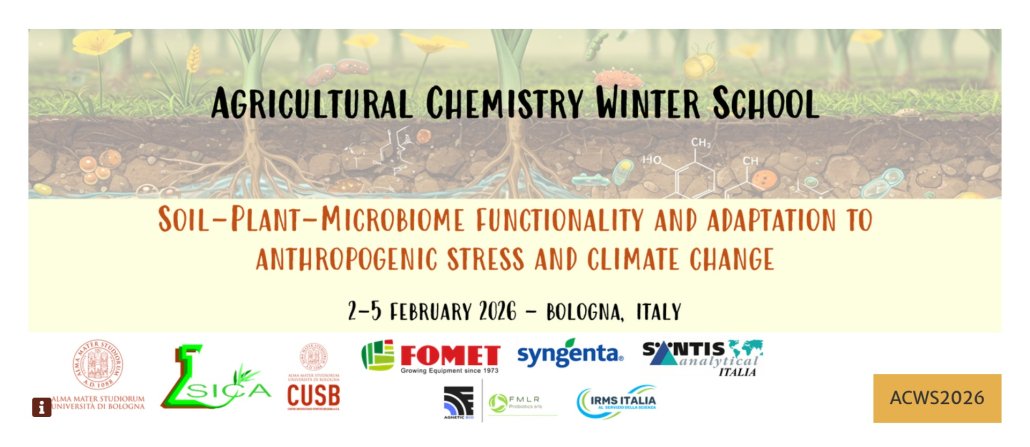
The event, organized by organized by the Italian Society of Agricultural Chemistry (SICA) and the University of Bologna will take place in February. Researchers can submit their contributions by December 12. The discussion will focus on sustainable agronomic strategies for the soil-plant-microbiome system
by Matteo Cavallito
There is time until December 12 to submit contributions (find all information here) to the Agricultural Chemistry Winter School scheduled to take place in Bologna from February 2 to 5, 2026. This event promises to explore a key topic such as the plant-soil-microbiome relationship in a scenario of climate change and anthropogenic interference through a special perspective: agricultural chemistry.
Hosted at the DAMSlab Auditorium of the University of Bologna, the four-day scientific event is meant for doctoral students, postdoctoral researchers, and early-stage researchers.
Sustainable solutions from agricultural chemistry
The combined presence of climatic and anthropogenic stress, together with the need to ensure food security for a growing population, highlights the importance of a comprehensive approach to the problem with clear agronomic and environmental implications. Faced with the increasing frequency of extreme events—such as heavy rains, which cause landslides and floods, and prolonged droughts—it is therefore necessary to promote soil resilience and resistance.
In this regard, the organizers emphasize how “agricultural chemistry plays a pivotal role by facilitating the identification of management strategies for the soil-plant-microbiome system.”
These strategies, they continue, “are to be aligned with prevailing policies that are oriented towards environmental sustainability and the promotion of a circular economy.” Strategies include practices such as the use of organic fertilizers, biostimulants, nanofertilizers, growth-promoting microorganisms, and “biodegradable bioplastic as alternatives to conventional plastics .” The expected result is the maintenance or improvement of soil fertility and quality, which is reflected in increased plant growth and enhanced nutritional value.
The program
Organized by the Italian Society of Agricultural Chemistry (SICA) and the Department of Agricultural and Food Sciences of Alma Mater Studiorum – University of Bologna, the February 2026 edition of the Winter School will address these issues while promoting the importance of research in the field of agricultural chemistry among young scientists on the international community. Main objective of the School is to provide an opportunity to:
- facilitate the exchange and extension of understanding of the theoretical, conceptual, and applicative aspects of soil ecology, plant, and environmental sciences;
- provide insights into novel methodological and analytical approaches while building research networks;
- consolidate scientific communication skills.
The program includes a series of activities, including conferences, seminars, and workshops, as well as presentations by participants. The sessions will address the topics of soil ecological relationships in the context of a changing environment; the ability of plants to adapt to climatic stresses; experimental field activity; and the valorization and reuse of organic biomass.
 Blonder1984, CC BY-SA 3.0
 Gareth James CC BY-SA 2.0 Attribution-ShareAlike 2.0 Generic
  Mokkie/Wikimedia Commons – CC BY-SA 3.0